Tuesday, May 12, 2015

How To Introduce Kids To Tough Topics? Art And TV Can Help

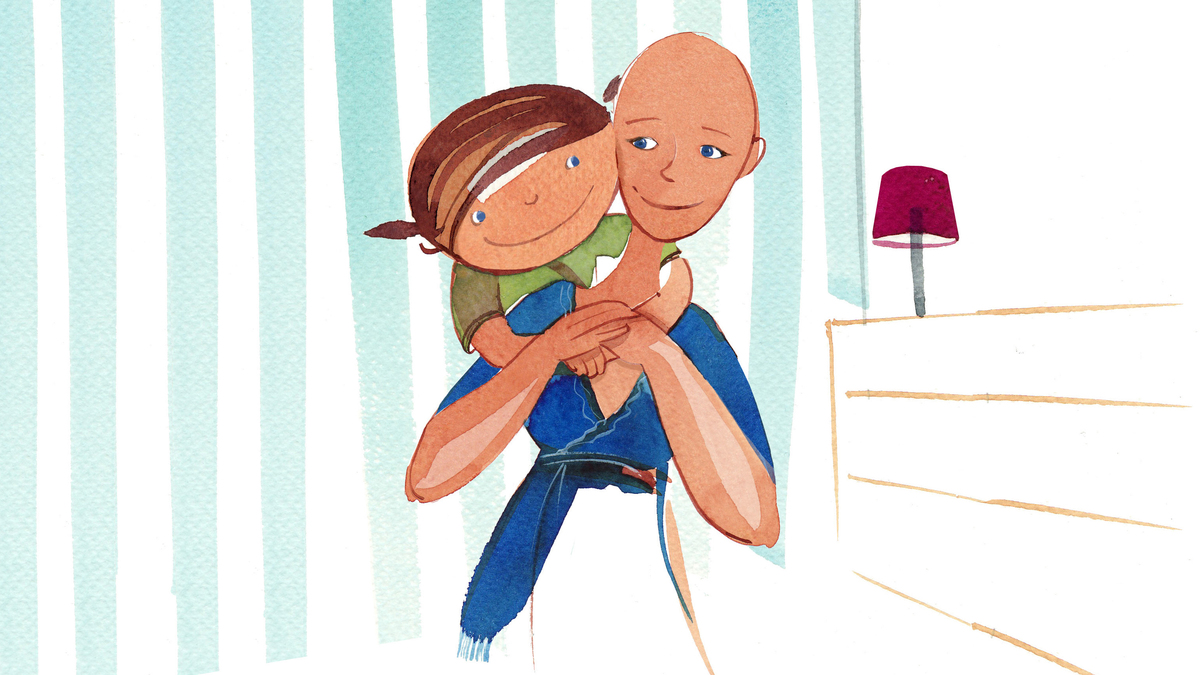
Sue Glader wrote Nowhere Hair after finding that many children's books about cancer were too depressing or scary. i

Sue Glader wrote Nowhere Hair after finding that many children's books about cancer were too depressing or scary. Courtesy Sue Glader hide caption
itoggle caption Courtesy Sue Glader
Sue Glader wrote Nowhere Hair after finding that many children's books about cancer were too depressing or scary.

Sue Glader wrote Nowhere Hair after finding that many children's books about cancer were too depressing or scary.

Courtesy Sue Glader

Parents steer their kids to media for all kinds of things: as a distraction so they can make dinner, to teach letters and numbers, and for pure entertainment. There are also times when parents rely on books, TV, museums and other media when they aren't quite sure how to approach a difficult topic by themselves.

Linda Ellerbee is the queen of hard subjects. Domestic abuse, Sept. 11, alcoholism and living with HIV are among the many tough issues she's covered in the 22 years since she's hosted NickNews on Nickelodeon. The show is written for 9- to 13-year-olds, and Ellerbee says her one rule of thumb is don't dumb it down.

"Our viewers are smart people," she says. "They are merely younger, less experienced and shorter." They also possess a more limited vocabulary, but Ellerbee she still uses words they might not know, like "intervention" or "hijacking."

"If I'm going to use a word that I think a 10-year-old might not understand," she says, "I either explain what the word means or use it in such a way that it's absolutely clear what the word means. I don't change the word."

NickNews is also known for letting kids do the talking: Children who've experienced all kinds of difficulties go on air to explain what their lives are like and how they're coping. Ellerbee says it's an effective way to explain a hard subject to young people. But, she cautions, don't do it too soon.

"That's why we haven't gone to Newtown yet to do a show with those kids or, you know, about what happened," she says. "It's about timing. You need to sort of let some things settle."

For the producers of Glee, meanwhile, the right time was four months after Newtown. Last April, the Fox series did an episode in which the high school goes on lockdown when a student's gun goes off. Some Newtown, Conn., residents urged people in the community to boycott the show.

The way adolescent brain works is such that 'bad things happen to other people' ... So what I think ['Glee'] did was to strike empathy and understanding amongst that age group.

- Dr. Jennifer Powell-Lunder

Psychologist Jennifer Powell-Lunder says the dangers of that Glee episode vary depending of who's watching it. "It is not a good show for kids who've been through such a trauma to be viewing," she says. "And it's very simple: Because it's too close to home, it retraumatizes them."

For teenagers who haven't experienced a similar tragedy, Powell-Lunder says, the episode was well done. "Really, the way the adolescent brain works is such that bad things happen to other people," she says. "So what I think it did is strike empathy and understanding amongst that age group and amongst all of us about the fear and the terror of the unknown."

The Right Book For Rough Subjects

In the late 1980s psychologist Jerome Singer warned, "Television is like having a stranger in the house." Most parents wouldn't want their children learning about the dangers of the world from a stranger, and that includes TV, he said when he was at Yale. At the same time, some parents need help starting the conversation. For young children, the right book can help, especially since reading together naturally lends itself to conversation.

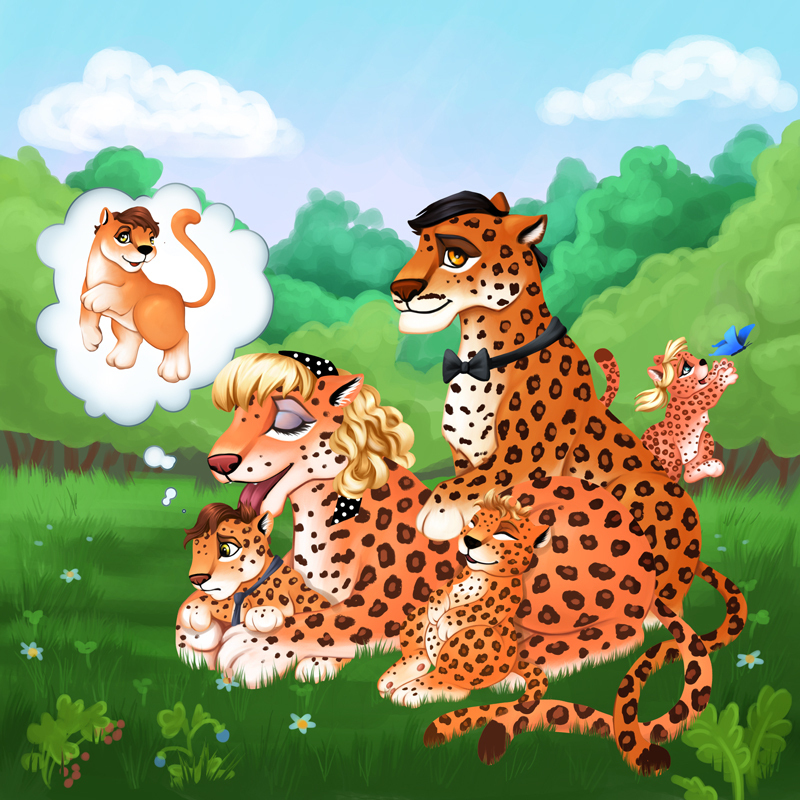
In When Leonard Lost His Spots, Leonard transitions from leopard to lioness. Here, Leonard is shown as a cub, dreaming of life without spots. i

In When Leonard Lost His Spots, Leonard transitions from leopard to lioness. Here, Leonard is shown as a cub, dreaming of life without spots. Courtesy Happy Family! hide caption
itoggle caption Courtesy Happy Family!
In When Leonard Lost His Spots, Leonard transitions from leopard to lioness. Here, Leonard is shown as a cub, dreaming of life without spots.

In When Leonard Lost His Spots, Leonard transitions from leopard to lioness. Here, Leonard is shown as a cub, dreaming of life without spots.

Courtesy Happy Family!

Case in point: The picture book When Leonard Lost His Spots: A Trans Parent Tail by Monique Costa addresses an issue you rarely find in children's literature — transgender. With playful rhymes and Disney-like illustrations, a tiger cub tells how he feels about his father becoming a female:

"I didn't know how to react.
Or even what to say.
I pretended not to notice him.
I wish he'd go away."

The cub feels shame, anger and fear. That openness is something publishers Cheril Clarke and Monica Bey-Clarke were drawn to. Their company, My Family!, focuses on children's books about nontraditional families. "It doesn't shy away from the fact that [the] cub is struggling inside," Clarke says. "It's a very honest story from a child's point of view."

But if a book for small children is too depressing, some adults just won't buy it. When Sue Glader was diagnosed with breast cancer, she went looking for books to read to her nieces and nephews. "I saw a lot of things that were really very sad and very scary or supertechnical for a young child," she says. So when she was going through chemotherapy, she wrote the book Nowhere Hair:

"A sparrow might have borrowed it to warm her fancy nest.
Perhaps she stuffed a pillow to help grandma get some rest.
The day I asked her where it went
She had a simple answer
'I'm bald because of medicine
I take to cure my cancer."

Glader's advice for talking to kids about hard subjects is be "silly ... in the right places."

Sculpting And Touching Tragedy

As hard as it might be to talk to a child about cancer, it's still a relatively concrete and present subject. Talking about difficult issues in the news is a different challenge. When it's the so-called "crime of crimes," many adults would rather not think about it at all, let alone talk about it with kids.

Artist and activist Naomi Natale is trying to get young people, as well as grown-ups, to understand genocide with a project called One Million Bones.

Pre-K through 12th-grade students at several hundred schools around the country have been sculpting human bones out of clay for a mass grave to be displayed on the National Mall to honor the victims of genocide.

At Georgetown Day Middle School in Washington, D.C., 12-year-old Cole Wright-Schaner made a spine. "It was kind of disturbing to make it, thinking of all the people that have died in the African countries," he says. "It really opened my eyes to genocide and what's going on in the world. We live in such a safe country."

Natale says the simple, physical process of making a bone is what makes genocide personal. "If you can think about the bone that's in your hand, and that you're using your hands to craft another bone, you know — representative of our lives and evidence we existed," she says.

Life-size wax figures at the National Great Blacks in Wax Museum depict the grim realities of slavery. i

Life-size wax figures at the National Great Blacks in Wax Museum depict the grim realities of slavery. Courtesy Great Blacks In Wax Museum hide caption

itoggle caption Courtesy Great Blacks In Wax Museum
Life-size wax figures at the National Great Blacks in Wax Museum depict the grim realities of slavery.

Life-size wax figures at the National Great Blacks in Wax Museum depict the grim realities of slavery.

Courtesy Great Blacks In Wax Museum

And young people can comprehend a difficult subject better by seeing it or touching it. At the National Great Blacks in Wax Museum in Baltimore, they get to do both.

Joanne Martin founded the museum with her late husband, Elmer Martin. They assembled an exhibition on slavery that is both extraordinary and grim: The museum has actual slave chains and shackles that visitors can hold. The weight alone drives home the brutality of slavery.

There's also a replica of a slave ship. Narrow, creaky steps take visitors down below. It's dark and there are life-sized statues of men, women and children with chains and shackles around their legs and their necks.

On a recent trip to the museum, fifth-grade teacher Damien Samuels said his students from KIPP Middle School in Charlotte, N.C., were "significantly affected" by the slave ship. He says teaching the complete story of slavery is challenging. It's easy to find stories about escaping slavery and abolitionists but most media skirt the really difficult parts.

"Even the textbooks shy away from certain images," Samuels says. "I think this museum does a very good job at showing the graphic details. So I think this is a very, very good opportunity for [the students] to really, really appreciate what their ancestors have been through."

The Great Blacks in Wax Museum also includes many stories that celebrate African-Americans' achievements over the decades, from civil rights to space exploration to the White House. Leaving young people with a sense of hope is important whenever media tackle hard subjects, says Nickelodeon's Linda Ellerbee.

"Wherever bad things happen, you always find good people trying to make it better," she says. "And there are more good people than there are bad people."

post from sitemap

What Kids Are Reading, In School And Out

A group of young adults reading i
iStockphoto.com
A group of young adults reading
iStockphoto.com

Walk into any bookstore or library, and you'll find shelves and shelves of hugely popular novels and book series for kids. But research shows that as young readers get older, they are not moving to more complex books. High-schoolers are reading books written for younger kids, and teachers aren't assigning difficult classics as much as they once did.

At Woodrow Wilson High School in Washington, D.C., the 11th-grade honors English students are reading The Kite Runner. And students like Megan Bell are reading some heavy-duty books in their spare time. "I like a lot of like old-fashioned historical dramas," Bell says. "Like I just read Anna Karenina ... I plowed through it, and it was a really good book."

But most teens are not forging their way through Russian literature, says Walter Dean Myers, who is currently serving as National Ambassador for Young People's Literature. A popular author of young-adult novels that are often set in the inner city, Myers wants his readers to see themselves in his books. But sometimes, he's surprised by his own fan mail.

"I'm glad they wrote," he says, "but it is not very heartening to see what they are reading as juniors and seniors." Asked what exactly is discouraging, Myers says that these juniors and seniors are reading books that he wrote with fifth- and sixth-graders in mind.

And a lot of the kids who like to read in their spare time are more likely to be reading the latest vampire novel than the classics, says Anita Silvey, author of 500 Great Books for Teens. Silvey teaches graduate students in a children's literature program, and at the beginning of the class, she asked her students — who grew up in the age of Harry Potter — about the books they like.

"Every single person in the class said, 'I don't like realism, I don't like historical fiction. What I like is fantasy, science fiction, horror and fairy tales.' "

Those anecdotal observations are reflected in a study of kids' reading habits by Renaissance Learning. For the fifth year in a row, the educational company used its Accelerated Reader program to track what kids are reading in grades one through 12.

"Last year, we had more than 8.6 million students from across the country who read a total of 283 million books," says Eric Stickney, the educational research director for Renaissance Learning. Students participate in the Accelerated Reader program through their schools. When they read a book, they take a brief comprehension quiz, and the book is then recorded in the system. The books are assigned a grade level based on vocabulary and sentence complexity.

And Stickney says that after the late part of middle school, students generally don't continue to increase the difficulty levels of the books they read.

Last year, almost all of the top 40 books read in grades nine through 12 were well below grade level. The most popular books, the three books in The Hunger Games series, were assessed to be at the fifth-grade level.

Last year, for the first time, Renaissance did a separate study to find out what books were being assigned to high school students. "The complexity of texts students are being assigned to read," Stickney says, "has declined by about three grade levels over the past 100 years. A century ago, students were being assigned books with the complexity of around the ninth- or 10th-grade level. But in 2012, the average was around the sixth-grade level."

Most of the assigned books are novels, like To Kill a Mockingbird, Of Mice and Men or Animal Farm. Students even read recent works like The Help and The Notebook. But in 1989, high school students were being assigned works by Sophocles, Shakespeare, Dickens, George Bernard Shaw, Emily Bronte and Edith Wharton.

Now, with the exception of Shakespeare, most classics have dropped off the list.

Back at Woodrow Wilson High School, at a 10th-grade English class — regular, not honors — students say they don't read much outside of school. But Tyler Jefferson and Adriel Miller are eager to talk. Adriel likes books about sports; Tyler likes history. Both say their teachers have assigned books they would not have chosen on their own. "I read The Odyssey, Tyler says. "I read Romeo and Juliet. I didn't read Hamlet. Asked what he thought of the books, Tyler acknowledges some challenges. "It was very different, because how the language was back then, the dialogue that they had.

Adriel agrees that books like that are tougher to read. "That's why we have great teachers that actually make us understand," he says. "It's a harder challenge of our brain, you know; it's a challenge."

But a challenge with its rewards, as Tyler says. "It gives us a new view on things."

Sandra Stotsky would be heartened to hear that. Professor emerita of education at the University of Arkansas, Stotsky firmly believes that high school students should be reading challenging fiction to get ready for the reading they'll do in college. "You wouldn't find words like 'malevolent,' 'malicious' or 'incorrigible' in science or history materials," she says, stressing the importance of literature. Stotsky says in the '60s and '70s, schools began introducing more accessible books in order to motivate kids to read. That trend has continued, and the result is that kids get stuck at a low level of reading.

"Kids were never pulled out of that particular mode in order to realize that in order to read more difficult works, you really have to work at it a little bit more," she says. "You've got to broaden your vocabulary. You may have to use a dictionary occasionally. You've got to do a lot more reading altogether."

"There's something wonderful about the language, the thinking, the intelligence of the classics," says Anita Silvey. She acknowledges that schools and parents may need to work a little harder to get kids to read the classics these days, but that doesn't mean kids shouldn't continue to read the popular contemporary novels they love. Both have value: "There's an emotional, psychological attraction to books for readers. And I think some of, particularly, these dark, dystopic novels that predict a future where in fact the teenager is going to have to find the answers, I think these are very compelling reads for these young people right now."

Reading leads to reading, says Silvey. It's when kids stop reading, or never get started in the first place, that there's no chance of ever getting them hooked on more complex books.

post from sitemap

Friday, May 8, 2015

Why are children so unhappy day today?


We live in one of the richest countries with the most advanced technology in the world. We had 60 years of peace and prosperity to free education and health care for all.

Our homes are full of labor-saving devices and electronic entertainment that previous generations could not even dream of. Surely our children are happier increasing every year?


Bored Girl


Well no. According to figures published last month, one in ten now suffers from a mental health problem clinically recognized, and earlier this year, a UNICEF report on "the welfare of the child" found that about 21 countries around British children in the developed world are most unhappy.

A damning survey by the National Consumer Council reported Mail revealed that children who watch too much television and spend hours on the Internet are "greedy and unhappy."

"These children speak with their families, have a lower opinion of their parents, and lower self-esteem than other children," said the report.

Even Gordon Brown moved to comment its determination to stop the "erosion of childhood."

So how this misfortune occur?

Well, there is evidence increasingly multiplication behavior problems in our schools today, even among very young children in primary schools. But many unfortunate to be calm, to bottle their children from poverty, and symptoms do not appear until adolescence.

Once again we see the proof: the UK has the worst drug problems, excessive drinking by minors and equality in Europe.

We are also near the top of international research for antisocial behavior, self-harm and eating disorders.

And according to data from the Public Policy Research Institute, last year 24,000 young people have attempted suicide - which is one every 22 minutes.

So what happens? After researching the state of modern childhood for more than five years, I am confident that, as our country has grown richer and more "advanced" growth, we lose sight of some fundamental truths about parenting .

We came to believe that 21 children of the world are different from children in the past - they can manage with less time and attention of parents, accelerate development and to face the charges and emotional pressures children should not have to face.

The brutal truth is they can not. Life may have changed much in recent decades, but the human brain evolves much more slowly - in fact, has not changed since the time of Cro-Magnon.

All babies are born as little babies Stone Age, and it is the parents - with the support of the community at large - to help them mature gradually equip with inner strength, skills and knowledge they need to live in a complex technological culture.

We can not let this matter, we can not opt ​​for it as individuals or as a society, and we can not waste bits on.

All adults in Britain - including politicians and businessmen that determine many aspects of our daily lives - must recognize that children's basic development needs has not changed over the millennia.

The most obvious are physical food, shelter and sleep.


play

"The explosion of obesity" in recent years shows that society - parents, manufacturers, distributors, even schools that feed Turkey Twizzlers kids - they have lost sight of the importance of healthy eating recent decades.

As for housing, who deceived overprotection, keep children wrapped in cotton to keep them "safe" and thus denying them essential opportunities to learn from the experience of real life - in fact continue their bikes and fresh air puff .

And in a 24/7 culture, where the dream has been marginalized by the electronic entertainment sparkles night, children can also get less sleep than any other time in human history.

Another basic need for emotional stability of the children who come to feel loved and safe.

Small babies, who can not feed or take care of themselves, need to know that someone cares for them at all times, and are programmed to recognize and respect that "someone" by sight, sound, smell, etc. . .

Thus, the caregiver must be a loving and constant constant presence in the life of the child.

We have a lot stolen puts many small children in daycare so that parents can go to work and feed the economy, rather than the baby.

As children grow, emotional security is associated regular, routine, such as family meals and familiar bedtime ritual.

Children need adults to not only love, but to provide regularly and to establish and maintain limits on their behavior. So parents must balance the heat with a degree of firmness.

This type of balanced breeding is very difficult when adults are exhausted by juggling work and domestic responsibilities or - in a materialistic society based on a philosophy "want" - do not know where the boundaries are to be developed.

If a child is used for dinner with the television every night, how do you tell them they can not do it because he finally realized that you never talk at all?

Or if, like millions of children have a television in their room, they see the end of the night, as they are taken to insist that, as they have exhausted every day?

It is even more difficult if, because of the pressures of modern life, marriage of a parent collapses or attempt to create a single child.

Children also need to learn communication skills, another key element in the emotional and social development.


Child

This begins from the moment they were born, and is an important part of the union with the caregiver that supports the emotional development.

As parents sing and talk to their babies, awakening the instinct wired deep into the language of the human brain and provide data through which children learn to speak their native language.

But if adults do not spend time with their children, communication skills will not develop as they should - and, in the busy modern world, many parents are not available to play its role in this process.

Many children now spend most of their day in care.

At home, babies are often sitting in front of a baby monitor, and as they grow, there is the problem of older children who have a TV in their room, meaning that even when the family is in the same building, its members are split off each.

Ironically, in a world where there are more ways to communicate than ever, parents communicate less with their children.

There is another absolutely essential ingredient if children are increasingly strong in body and mind - the lives of many children are virtually eradicated in the great concern of developmental psychologists,.

They have to play. They also have to play in a relaxed manner, without structure, preferably outside with other children and - as they age - far from the eyes of an eagle to adults.

The need for the game is embedded in the DNA of all higher animals - lions, for example, are programmed to play the game, the game rod and playFight to solve their place in the family hierarchy.

If you learn these life skills through the game Leo, the species would disappear.

Human children develop physical control and coordination by running, jumping, climbing, jumping or kicking a soccer ball.

Get a first hand experience of the world they will live, making mud pies or wading pools or stirring in a sand box, kart done at home or climb a tree.

These experiments support the understanding of the world that are based science and human learning - No games, education is also built on quicksand.

Without playing too much, it is likely that the imagination and creativity of children is delayed.

So, too, their social skills. It is by playing with other children - without interference from adults - that young people learn to make friends, resolve conflicts, work collaboratively and actually prevent small enemies.

They also learn to take "security risks" and make their own judgments, developing independence and self-sufficiency.

As for the games, our society has not only the eye of the ball, he lost control of it.

Our paranoid obsession "health and safety", many parents now keep their children locked inside a sedentary life based on the screens.

"Play" is set in a PlayStation, Game Boy into one, and children often spend their days watching TV without thinking.

This terrible scenario was the subject of the report by the National Consumer Council this week as found in millions of homes "seems to be always present, especially during meals screen."

As the Prime Minister said, this "child is exposed to very aggressive advertising pressures."

This creates a generation of mini-consumers who want everything they see on the screen and equate happiness with materialism.

"Safe" in their rooms, our young people learn about the lives of people they see on the screen - pop stars, celebrities and other care-seekers - and the army anonymous traders behind these screens.

And the message of these celebrities and retailers is that happiness comes from being rich and famous, the last property Musthave products, and a "cool" lifestyle.

All these changes in the lifestyle of children are rapid social and cultural change side, driven by new technologies and consumption of one of the consequences of society increasingly competitive.

Nobody expected - in fact, we were so rushed off our feet do not realize they occur - but together hold a cocktail toxic side effects "of progress."

The statistics now emerging - I was talking about earlier - about the mental health of children should act as a wake up call to parents, politicians and the nation as a whole.

Because they are increasingly a land of peace and abundance, misfortune is not a natural state for our children.

Of course, there are some unfortunate souls genetically predisposed to depression, but most people develop a natural resistance. Natural fear toughness becomes absent in today's children, because the development needs described above are not met.

Unfortunately, children face challenges today are also highly toxic.

Two other side effects of cultural change were the strong increase in marketing pressure on children and a simultaneous increase in pressures they face at school. We now live in a culture of winners and losers.

Meanwhile, the obsession with competition also infects primary schools, which abound with evidence, objectives and achievements rankings even for young children.

Children now face a maximum of 70 academic tests before age 16 We have our offspring for this High stakes rats educational career at an earlier age than in any other country, and many engage in formal learning at the tender age four.

At this age, many children (especially boys) are not physically competent to hold a pencil, much less write.

However, now that we have become aware of the problem of childhood unhappiness, there is no reason why we can not find a solution.

Since we know what it takes to open happy, successful, healthy children (the recipe is now ratified by Neuroscience Research decades), such an advanced society like ours should be able to provide it.

A good start would be to organize the market, which is now more and more predator against children, and to change the culture goals and primary school tests.

Our consumer culture, with the breakup of extended families and greater mobility, has been broken in the last set of trusted communities.

Parents, teachers and other members of the community must find ways to re-forge an "alliance for adults" in your community to help families raise their young.

The primary responsibility for the education of children, however, is - as always - with parents.

They must realize, no longer paralyzed by a combination of rapid change, uncertainty and guilt, and finding new ways to provide healthy family life insurance for your children.

None of this is rocket science, but in terms of the future of our nation is more important than rocket science.

Unless very soon we will begin participating in the welfare of our children (our children) and to address the mental health problems growing, the next generation can not be bright enough or balanced to maintain our healthy economy and our nation as a whole


25 How to draw for kids instructions - using letters

Children can learn to draw using much faster cards. Children at a young age learn to recognize English alphabets through graphics or toys or be taught in nurseries. But they begin to scribble drawing as long to learn how to write alphabets. Drawing becomes interesting and easy to understand when introduced with alphabets. Of course, the basic shapes are widely used to help them learn the design, but using letters and forms or without using forms is much easier. Imagine how we can make a simple puppet, with the help of the letter "A" or a rainbow with the use of letters 'B' and 'C' and so on.

The design is very important to start at a very young age because children are very prone to design and, in addition, they hardly have any kind of pressure from the study. Even at the age of 6-8 years is not so much study and is easy for parents to engage their children in another activity. Design and improve wrist movement also makes learning many new things.

Outside the group, some of the easy instructions how to draw using only letters. I hope you enjoy them and help your child learn these simple drawings as I do.


How to draw an umbrella - letter D and J

Draw an inverted D,

Levy on J D

Make five curves in sleep line

Rub the line leaving the corners,

Double J up

Draw a circle with the umbrella from the center,

Join the points to this central umbrella circle.


How to draw a birthday hat and clown - using letters "A" and "U"

To draw 'A'

Join the bottom edges with a straight line,

Draw wavy lines driving,

Decorate the cover with simple lines and shapes,

Add to face Joker "U" on the bottom of 'A'

Add eyes, nose, mouth and ears,

Draw the neck and finally call the three layers of ruffles.


Friday, April 17, 2015

25 How to draw for kids instructions - using letters

Children can learn to draw using much faster cards. Children at a young age learn to recognize English alphabets through graphics or toys or be taught in nurseries. But they begin to scribble drawing as long to learn how to write alphabets. Drawing becomes interesting and easy to understand when introduced with alphabets. Of course, the basic shapes are widely used to help them learn the design, but using letters and forms or without using forms is much easier. Imagine how we can make a simple puppet, with the help of the letter "A" or a rainbow with the use of letters 'B' and 'C' and so on.

The design is very important to start at a very young age because children are very prone to design and, in addition, they hardly have any kind of pressure from the study. Even at the age of 6-8 years is not so much study and is easy for parents to engage their children in another activity. Design and improve wrist movement also makes learning many new things.

Outside the group, some of the easy instructions how to draw using only letters. I hope you enjoy them and help your child learn these simple drawings as I do.


How to draw an umbrella - letter D and J

Draw an inverted D,

Levy on J D

Make five curves in sleep line

Rub the line leaving the corners,

Double J up

Draw a circle with the umbrella from the center,

Join the points to this central umbrella circle.


How to draw a birthday hat and clown - using letters "A" and "U"

To draw 'A'

Join the bottom edges with a straight line,

Draw wavy lines driving,

Decorate the cover with simple lines and shapes,

Add to face Joker "U" on the bottom of 'A'

Add eyes, nose, mouth and ears,


Draw the neck and finally call the three layers of ruffles.


IL ETAIT UN VERNIS: ONCE UPON A TIME COLLECTION SWATCHES


Once Upon a Time Nail Polish Collection


Once upon a time which is the first collection of Il était The Vernis, the indie brand launched by two fabulous bloggers French nails - Vernis en Folie and De tout et de rien. The brand launched in late 2014 and has gone from strength to strength with two new collections of colors and a range of nail added to the list since. What really attracts me to this brand is fascinating and approach completion "something for everyone" every collection.


Each nail Il était The Vernis is 5-free and vegan. Designed and manufactured in France, Australia, I can safely say that this is one of the most impressive collections I have ever seen. All five of these shadows blew me away when I laid eyes on them. There are 4 dispersed holographic nail and a bright gold (also holographic) glitter. All holos has an incredibly bright and smooth to apply gelatinous consistency that makes while brightness is dense enough to provide a complete or perfect cover takes another shadow as an ornament. Let's take a closer look ...


Il Etait Un Vernis | Beyond Words Pink Nail Polish Swatch

BEYOND WORDS

- 3 Coats + Top Coat

Let's dive right into the show-stopper! More than words is a beautiful fuchsia shade devastatingly filled with holographic particles and bright pink spots. The super brightness is strong with this one, but I always add a top coat for durability. Even my favorite rose at a time and my choice of collection.


Il Etait Un Vernis | Beyond Words by @thesammersaurus


Il Etait Un Vernis | Crush on Blue Nail Polish Swatch

CRUSH ON BLUE

- 3 Coats + Top Coat

If you're looking for a royal blue with a twist, look no further than Crush on Blue. Smooth application in 3 coats.


Il Etait Un Vernis | Crush on Blue by @thesammersaurus


Il Etait Un Vernis | Light Box Black Holographic Glitter Polish

LIGHT BOX

- 3 Coats + Top Coat

Light Box has a slightly thicker formula than the others but it was smooth enough to apply without any issues. There's something very luxurious about a black holographic and the blue flecks are a genius touch.


Il Etait Un Vernis | Light Box by @thesammersaurus


Il Etait Un Vernis | Live, Love, Laugh Gold Glitter Nail Polish Swatch

LIVE, LOVE, LAUGH

- 3 Thin Coats Over Bare Nails + Top Coat

With three coats of Live, Love, Laugh on my naked nails, there are still a few spots where you can see through but only if you look very closely. With all that light bouncing around, the naked spots are invisible to the naked eye and it looks just like you dipped your nails in glitter!


Il Etait Un Vernis | Live, Love, Laugh by @thesammersaurus


Il Etait Un Vernis | No Comment - Coral Holographic Nail Polish Swatch

NO COMMENT

- 3 Coats + Top Coat

No Comment is a very summery shade and one of those in-between shades that's hard to describe so I'll just let the pictures do most of the talking. I wouldn't quite class this as a coral but perhaps a bright red with orange tendencies!


Il Etait Un Vernis | No Comment by @thesammersaurus

WHERE TO BUY ONCE UPON A TIME

Once Upon a Time is available for a limited time from Il Etait Un Vernis Shop (in France) and their International Stockists (for everywhere else in the world). RRP €12.90 (~$14.25 / £9.50).


Monday, March 30, 2015

Study Finds Parents Low-Ball Obese Children’s Weight

A new study has found that parents of obese children may not be able to recognize their child is overweight, unless they are at very extreme levels of obesity.

Researchers from the London School of Hygiene & Tropical Medicine and University College of London (UCL) Institute of Child Health, a research partner of Great Ormond Street Hospital, also found that parents are more likely to underestimate their child’s weight if they are black or South Asian, from more deprived backgrounds, or if their child is male.

As childhood obesity has increased in the UK, the government has put in place interventions to tackle the problem, the researchers noted. But it was suggested that many parents can’t identify when their child is overweight, leading to questions about the effectiveness of current interventions designed to address obesity in the home.

The research team set out to look at this problem and identify socioeconomic factors that may predict a parent’s inability to estimate their child’s weight correctly.

Questionnaires were filled out by the parents of 2,976 children in five primary care trusts taking part in the National Child Measurement Program: Redbridge, Islington, West Essex, Bath and North East Somerset, and Sandwell.

The researchers discovered that 31 percent of parents (915) underestimated where their child’s Body Mass Index (BMI) sat on government obesity scales, which classify children as very overweight (or obese), overweight, healthy weight, or underweight.

In fact, the researchers report they found only four parents described their child as being very overweight despite 369 children being officially identified as very overweight according to the BMI cut-off.

According to official guidelines, children are classified as overweight at the 85th centile and very overweight (or obese) at the 95th centile. The researchers found that for a child with a BMI at the 98th centile there was an 80 percent chance the parent would classify their child as healthy weight. Parents did become more likely to classify their child as overweight when the child had a BMI above the 99.7th centile, the researchers found.

“If parents are unable to accurately classify their own child’s weight, they may not be willing or motivated to enact the changes to the child’s environment that promote healthy weight maintenance,” said senior author Dr. Sanjay Kinra, a reader in Clinical Epidemiology at the London School of Hygiene & Tropical Medicine and co-lead investigator of the PROMISE trial.

Co-author Professor Russell Viner, academic pediatrician at the UCL institute of Child Health and PROMISE co-lead investigator added: “Measures that decrease the gap between parental perceptions of child weight status and obesity scales used by medical professionals may now be needed in order to help parents better understand the health risks associated with overweight and increase uptake of healthier lifestyles.”

The study, published in the , is part of the PROMISE (Pediatric Research In Obesity Multi-Modal Intervention And Service Evaluation) study, a five-part project that aims to improve the assessment and treatment of childhood obesity through research.

Source:

Wood, J. (2015). Study Finds Parents Low-Ball Obese Children’s Weight. . Retrieved on March 30, 2015, from http://psychcentral.com/news/2015/03/29/study-finds-parents-underestimate-obese-childrens-weight/82865.html
post from sitemap